A top predator suddenly stalking Texas nilgai has biologists rethinking everything they knew about the region’s wildlife. The antelope, introduced decades ago, now faces a hunter that shouldn’t logically exist in that ecosystem.
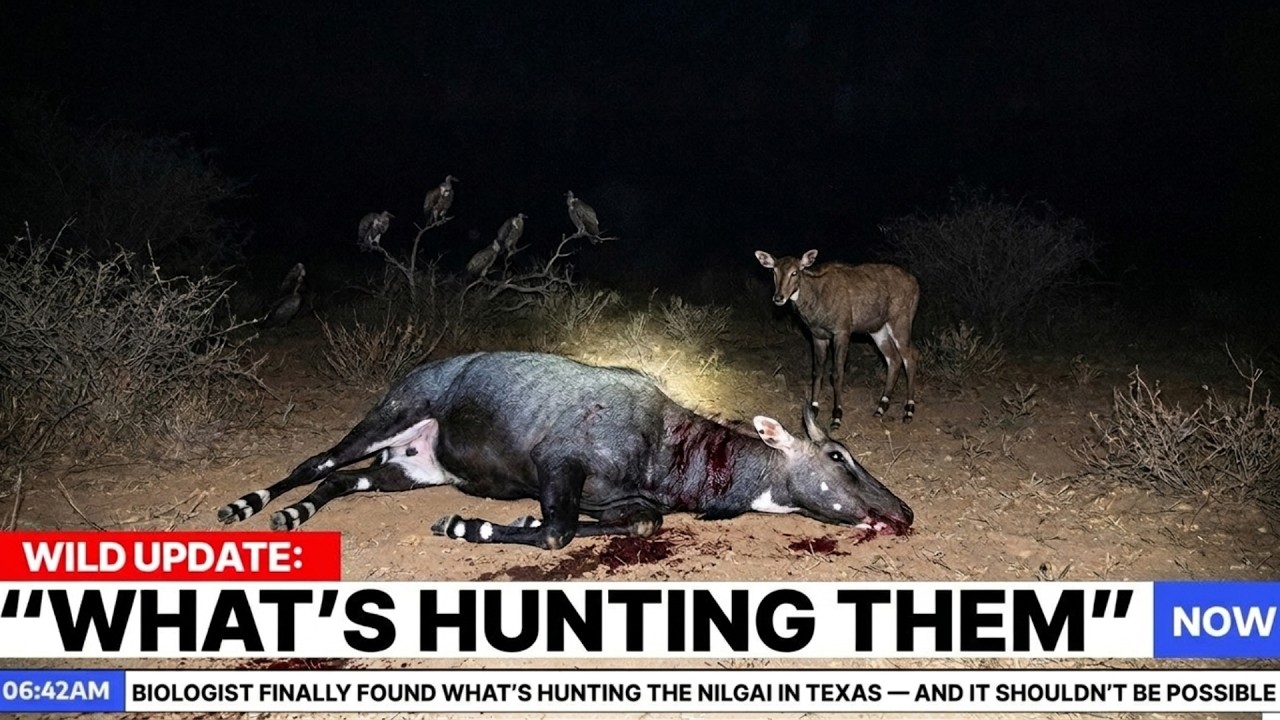
In the brush country of South Texas, researchers have found evidence that mountain lions are killing adult nilgai, a large antelope species introduced to the region about a century ago. Until recently, biologists believed no wild predator in Texas could take down a fully grown nilgai.
The discovery came after ranch staff found a dead adult nilgai in a thicket north of Kingsville. The animal, nearly five feet tall at the shoulder and close to 500 pounds, had been fed on across several nights. Initially, the cause was unclear. Researchers working on nearby land later reviewed GPS collar data and identified mountain lions as the predators.
Nilgai were first brought to the King Ranch in 1924 by Caesar Kleberg, who was managing the property’s wildlife program at the time. Working with the San Diego Zoological Garden, Kleberg had several nilgai shipped to the ranch’s Norias division in Kenedy County. The reasons for the introduction remain uncertain, according to Western Cohalla, the ranch’s assistant area manager of wildlife operations. He told Texas Highways that Kleberg’s motives were obscure. The first animals struggled to establish themselves, and additional shipments, including a final one in 1941, were needed before the herd took hold.
The animals adapted well to the South Texas landscape, which resembles the dry scrub of their native India and Pakistan. Nilgai are large animals. A big bull can weigh up to 600 pounds, with some reaching about 675 pounds, according to Texas Tech’s account of the mammals of Texas. They stand nearly five feet at the shoulder and can run about 30 miles per hour. They also cover large distances, with radio collar studies in the early 2000s showing home ranges from a few thousand acres to more than 70,000 acres.
In their native range, nilgai face predators including tigers, leopards, wolves, and dholes. Texas has none of those. Coyotes can take newborn calves, but they are too small to kill a full-grown nilgai. For most of the past century, the only regular causes of death for adult nilgai in Texas were hunting, vehicle collisions, and severe cold weather. Nilgai have thin coats and little winter fat, and a hard winter can kill thousands. But the population has continued to grow steadily. From a small founding herd, numbers reached about 200 by the mid-1950s and rose to roughly 15,000 by 2004. The East Foundation’s spring 2026 newsletter estimates the current population at 37,000 to 50,000.
Because nilgai are classified as exotics in Texas, they can be hunted year-round with no bag limit. The King Ranch alone harvests about 1,000 annually. Federal crews also cull them at Laguna Atascosa National Wildlife Refuge. Despite these efforts, the population continues to climb.
The mountain lions responsible for the new kills are part of a small and fragile population. Texas is the only state that allows mountain lions to be killed without regulation and relies solely on voluntary reports when one is killed. Lions in South Texas are concentrated in the brush country along the border, with an estimated population of only a few hundred cats, compared with roughly 4,000 in West Texas. The South Texas group has one of the lowest reported densities of lions in North America.
The last major study of South Texas lions ran from 1994 to 1997 along the Nueces River. Researchers collared 19 lions and found they selectively killed white-tailed deer, along with javelina, feral hogs, and sheep. No nilgai appeared on that list. The newer kill sites, however, show a different pattern. Researchers checking GPS clusters have found adult nilgai carcasses, including cows and young bulls, dragged into cover and fed on over several nights. One kill involved an animal roughly the size of a small horse.
The size difference between the cats and their prey is considerable. The first two lions collared by the South Texas Lion Project in February 2024 weighed 118 and 116 pounds. A nilgai cow can weigh up to about 470 pounds, roughly four times as much. Lions elsewhere do take large prey, including elk and moose in Alberta, Canada. But the South Texas cats were previously seen as careful deer and javelina hunters. Biologists handling these lions have found healed rib fractures and puncture wounds on some cats, indicating the hunts carry physical risk.
The reaction among ranchers varies. Some are concerned about the threat to calves and working dogs. Others are interested in the return of a predator they had assumed was gone from the region.
The scientific community is not treating this as an unqualified success. The South Texas lion population has declined significantly. A genetic study from Texas A&M University-Kingsville, published in 2012, found that the effective size of the southern Texas population had fallen by more than half since the 1930s and 1940s, with genetic diversity dropping by 10 to 20 percent. Texas Parks and Wildlife describes the South Texas population as declining, increasingly isolated, and potentially at risk of disappearing from the region altogether. The border barrier between the United States and Mexico may also be cutting the cats off from lion populations in Mexico that could provide fresh genetic material.
The researchers leading the lion project say it remains unclear whether the predation on nilgai represents a meaningful ecological shift or a temporary development. It could be that only a few individual lions have learned to kill nilgai, and the behavior may disappear when those cats die. Alternatively, mothers may be passing the technique to their young, which would spread it slowly across generations. Because so few lions wear collars, much of the land is private, and scavengers often strip kill sites quickly, researchers cannot yet determine how widespread the behavior is.
The legal framework in Texas has not caught up with the changing dynamics. Mountain lions can still be killed on any day of the year with no limits and no requirement to report the kill. In 2022, a coalition called Texans for Mountain Lions petitioned the state to require reporting of lion kills within 48 hours, to limit trapping, and to establish a five-lion annual limit in South Texas. The commission adopted a rule requiring traps to be checked every 36 hours and banned canned hunts, but the reporting requirement and the South Texas limit were not approved. Texas Parks and Wildlife completed its first 10-year management plan for mountain lions in late 2025, and a voluntary reporting feature was added to the Texas Hunt and Fish app.
For now, the relationship between the two animals has changed in the brush country, but the broader implications remain unclear. The South Texas lion population is small, genetically limited, and only partially understood. Whether it can sustain the behavior that has recently drawn attention, and what that means for the nilgai herd, are questions that remain open.
Recommended Stories

A fisherman’s camera caught a giant squid doing something marine biologists never imagined. Off a remote coast, the creature descended toward the deep, not fleeing, but pausing near the bait line.
Giant squid were known to science for centuries before anyone ever saw one alive. Sailors across different cultures described enormous...

Deep in the Mariana Trench, over 38,000 feet below the surface, cameras captured something moving—an organism thriving where crushing pressure should make survival impossible. Scientists were baffled because this creature appeared far more complex than the simple microbes expected in such extreme darkness.
The pressure at the bottom of the Mariana Trench reaches roughly eight tons per square inch, and sunlight never reaches...
Montana’s grizzly population had plummeted to just 386 bears, a fragile remnant teetering on the edge of regional extinction. Wildlife managers faced a brutal choice: intervene aggressively or watch the species vanish from the lower 48 states.
In the early 1980s, a count of grizzly bears in the mountains of northwestern Montana found 386 animals left in...